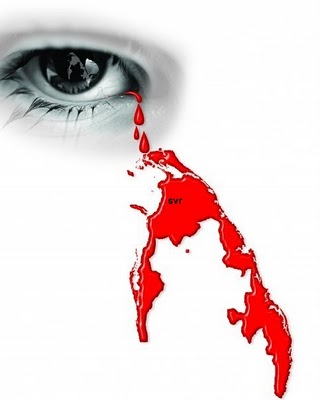
Remarks Of Tamil Genocide in Sri Lanka:
Friday, February 26, 2010
British Shadow FM calls for political reform, independent war-crime investigations
Noting that "there is a natural affinity between Tamils in Britain and our [Conservative] Party," William Hague, the British Shadow Foreign Secretary, in his speech to the inaugural launch of Global Tamil Forum, warned that the "continued confinement [of thousands] will simply sow the seeds of discontent, [and] could lead to renewed conflict in years to come," called for "meaningful political reform," and said that "there should be a full independent inquiry into alleged war crimes committed by both sides during the final stages of the military conflict

Denmark goes for Tamil referendum Sunday
Eezham Tamils in Denmark will cast their ballot in 32 centres across the country in a referendum on the question of independent and sovereign Tamil Eelam in the North and East of the island of Sri Lanka. The referendum will be conducted by a professional institute TNS Gallup, specialised in sociological and public opinion research services, deploying electronic system for confidential voting, says Dr. Remmon Washington, the spokesperson of the Denmark Tamils Forum formation committee, which has initiated the poll. The total number of eligible Eezham Tamil voters in Denmark is estimated to be ranging around 6,500.
All polling booths will be supervised by a non-Tamil representative, who will liaise with TNS Gallup and will be responsible for giving the individual password necessary for electronic voting at the booth.
When voters enter the password, the statement for the referendum and three columns, 'yes', 'no' and 'blank', will appear in the screen for the voters to choose and submit.
Dr. Remmon WashingtonThe committee appealed to all eligible Eezham Tamil voters to prove solidarity in democratic approach to the national question, through overwhelming participation.
Even though small in number, voters in Denmark have to be conscious about the significant impact they could make, as successful referenda in several diaspora countries have proved it domestically and internationally, says Dr. Remmon Washington, an Eezham Tamil physician who came to Denmark in 1987 at the age
All polling booths will be supervised by a non-Tamil representative, who will liaise with TNS Gallup and will be responsible for giving the individual password necessary for electronic voting at the booth.
When voters enter the password, the statement for the referendum and three columns, 'yes', 'no' and 'blank', will appear in the screen for the voters to choose and submit.
Dr. Remmon WashingtonThe committee appealed to all eligible Eezham Tamil voters to prove solidarity in democratic approach to the national question, through overwhelming participation.
Even though small in number, voters in Denmark have to be conscious about the significant impact they could make, as successful referenda in several diaspora countries have proved it domestically and internationally, says Dr. Remmon Washington, an Eezham Tamil physician who came to Denmark in 1987 at the age
Friday, January 8, 2010
Video authentic, Alston calls for wider war crimes probe
Philip Alston, the Special Rapporteur on extrajudicial, summary or arbitrary executions, in a press meet today called for wider investigations into allegations of war crimes in Sri Lanka after three forensic experts hired by Alston and two previous independent analyses by Times On Line (UK), and a Colorado firm confirmed the authenticity of the video broadcast by Channel-4 in August.
Full text of the article appearing in UN News Center follows:
An independent United Nations human rights expert said today there are strong indications that the video of alleged extrajudicial executions by Sri Lankan soldiers that aired last August on British television is authentic, and called for an inquiry into possible war crimes committed during the conflict with Tamil rebels.
Philip Alston, the Special Rapporteur on extrajudicial, summary or arbitrary executions, commissioned three experts in forensic pathology, forensic video analysis, and firearm evidence to examine the video, after concluding that the investigations carried out by the Government had not been thorough or impartial.
“The conclusion clearly is that the video is authentic,” he told a news conference in New York. “I have therefore called on the Government of Sri Lanka to respond to these allegations.”
The Government – which earlier this year declared victory over the rebel Liberation Tigers of Tamil Eelam (LTTE) after years of fighting – has categorically denied the allegations raised by the video, which purportedly depicts the extrajudicial execution of two naked and helpless Tamil men by the Sri Lankan military and the presumed prior executions of others.
It had commissioned four separate investigations which concluded that the video was a fake. However, Mr. Alston had pointed out that two of the Government’s experts looking into the matter were members of the Sri Lankan Army, the body whose actions have been called into question.
Meanwhile, the reports by the three experts from the United States commissioned by Mr. Alston to examine the video “strongly suggest that the video is authentic,” according to a note prepared by the Special Rapporteur.
Peter Diaczuk, an expert in firearms evidence, concluded that the recoil, movement of the weapon and the shooter, and the gases expelled from the muzzle in both apparent shootings were consistent with firing live ammunition, and not with shooting blank cartridges.
Daniel Spitz, a prominent forensic pathologist, found that the footage appeared authentic, especially with respect to the two individuals who are shown being shot in the head at close range. He found that the body reaction, movement, and blood evidence was entirely consistent with what would be expected in such shootings.
Jeff Spivack, an expert in forensic video analysis, found no evidence of breaks in continuity in the video, no additional video layers, and no evidence of image manipulation.
“Given these conclusions, and in light of the persistent flow of other allegations of extrajudicial executions by both sides during the closing phases of the war against the LTTE, I call for the establishment of an independent inquiry to carry out an impartial investigation into war crimes and other grave violations of international humanitarian and human rights law allegedly committed in Sri Lanka,” stated Mr. Alston.
He added that there are a small number of characteristics of the video which the experts were unable to explain, including the movement of certain victims in the video, 17 frames at the end of the video, and the date of 17 July 2009 encoded in the video (the conflict was officially declared over in May 2009).
“Each of these characteristics can, however, be explained in a manner entirely consistent with the conclusion that the videotape appears to be authentic,” noted a news release also issued today.
“In sum, while there are some unexplained elements in the video, there are strong indications of its authenticity. In addition, most of the arguments relied upon by the Government of Sri Lanka to impugn the video have been shown to be flawed.”
In a separate development, Secretary-General Ban Ki-moon has informed the Sri Lankan Government that he is considering the appointment of a Commission of Experts to advise him further and to assist the Government in taking measures to address possible violations of international human rights and humanitarian law.
Mr. Ban’s spokesperson, Martin Nesirky, told reporters that the UN is in regular contact with the Government regarding the implementation of the joint statement issued in May at the conclusion of the Secretary-General’s visit to Sri Lanka.
In that statement, Mr. Ban had underlined the importance of a comprehensive accountability process for addressing violations of international humanitarian and human rights law, and the Government undertook to take measures to address grievances of the victims of the conflict.
Full text of the article appearing in UN News Center follows:
An independent United Nations human rights expert said today there are strong indications that the video of alleged extrajudicial executions by Sri Lankan soldiers that aired last August on British television is authentic, and called for an inquiry into possible war crimes committed during the conflict with Tamil rebels.
Philip Alston, the Special Rapporteur on extrajudicial, summary or arbitrary executions, commissioned three experts in forensic pathology, forensic video analysis, and firearm evidence to examine the video, after concluding that the investigations carried out by the Government had not been thorough or impartial.
“The conclusion clearly is that the video is authentic,” he told a news conference in New York. “I have therefore called on the Government of Sri Lanka to respond to these allegations.”
The Government – which earlier this year declared victory over the rebel Liberation Tigers of Tamil Eelam (LTTE) after years of fighting – has categorically denied the allegations raised by the video, which purportedly depicts the extrajudicial execution of two naked and helpless Tamil men by the Sri Lankan military and the presumed prior executions of others.
It had commissioned four separate investigations which concluded that the video was a fake. However, Mr. Alston had pointed out that two of the Government’s experts looking into the matter were members of the Sri Lankan Army, the body whose actions have been called into question.
Meanwhile, the reports by the three experts from the United States commissioned by Mr. Alston to examine the video “strongly suggest that the video is authentic,” according to a note prepared by the Special Rapporteur.
Peter Diaczuk, an expert in firearms evidence, concluded that the recoil, movement of the weapon and the shooter, and the gases expelled from the muzzle in both apparent shootings were consistent with firing live ammunition, and not with shooting blank cartridges.
Daniel Spitz, a prominent forensic pathologist, found that the footage appeared authentic, especially with respect to the two individuals who are shown being shot in the head at close range. He found that the body reaction, movement, and blood evidence was entirely consistent with what would be expected in such shootings.
Jeff Spivack, an expert in forensic video analysis, found no evidence of breaks in continuity in the video, no additional video layers, and no evidence of image manipulation.
“Given these conclusions, and in light of the persistent flow of other allegations of extrajudicial executions by both sides during the closing phases of the war against the LTTE, I call for the establishment of an independent inquiry to carry out an impartial investigation into war crimes and other grave violations of international humanitarian and human rights law allegedly committed in Sri Lanka,” stated Mr. Alston.
He added that there are a small number of characteristics of the video which the experts were unable to explain, including the movement of certain victims in the video, 17 frames at the end of the video, and the date of 17 July 2009 encoded in the video (the conflict was officially declared over in May 2009).
“Each of these characteristics can, however, be explained in a manner entirely consistent with the conclusion that the videotape appears to be authentic,” noted a news release also issued today.
“In sum, while there are some unexplained elements in the video, there are strong indications of its authenticity. In addition, most of the arguments relied upon by the Government of Sri Lanka to impugn the video have been shown to be flawed.”
In a separate development, Secretary-General Ban Ki-moon has informed the Sri Lankan Government that he is considering the appointment of a Commission of Experts to advise him further and to assist the Government in taking measures to address possible violations of international human rights and humanitarian law.
Mr. Ban’s spokesperson, Martin Nesirky, told reporters that the UN is in regular contact with the Government regarding the implementation of the joint statement issued in May at the conclusion of the Secretary-General’s visit to Sri Lanka.
In that statement, Mr. Ban had underlined the importance of a comprehensive accountability process for addressing violations of international humanitarian and human rights law, and the Government undertook to take measures to address grievances of the victims of the conflict.
Saturday, December 5, 2009
Holding transnational government above collaboration politics
For the first time in the history of Eezham Tamils they have moved to evolve an international polity for themselves, independent of armed struggle, through the concept of transnational governance. The space available today, especially in the diaspora, has to be made the best use of in forging an innovatively democratic structure that should be contributing not only to the cause of Eezham Tamils, but also challenging and shaping a global system that is inadequate in handling a crisis like that of Eezham Tamils. Conceiving the transnational government as a 'post-defeat' organ for collaboration will be the greatest ever tragedy in the polity of Eezham Tamils.
TamilNet Editorial BoardTransnational government is an innovative concept and a major political step Eezham Tamils in the diaspora opted for after the war in Vanni.It is now six months since the efforts were called for and is thus time for stock taking.Even though the transnational move suffers from an inherent liability that it was insinuated by factional politics at the very outset, that should not be allowed to discredit the noble cause, and the diaspora Tamils should act vigilantly and boldly if necessity arises for any course correction.The most fundamental problem with the transnational move is that it has failed to bring out the national aspiration and aim of Eezham Tamils in concrete terms. Mincing with words and harping on ambiguous concepts are not ways to lay a sound foundation to the novel and global political move.Why the hesitation in telling that the Transnational Government of Tamil Eelam is conceived to globally represent the national aspiration of Eezham Tamils to form an 'independent and sovereign state of Tamil Eelam' in the island of Sri Lanka?If it is argued that laying the political foundation is the work of the first assembly elected, then there should have been total abstention from telling anything at all – neither the phrase right to self-determination nor the nametag Tamil Eelam.On the contrary, some of the functionaries and some personalities claiming as supporters of the transnational move have entered into controversy in the last few months in many countries by openly opposing democratic political moves upholding national aspirations such as the re-mandate of the main principle of Vaddukkoaddai Resolution and the formation of Country Councils that stand for independent and sovereign Tamil Eelam. Thus they have created an image that the transnational move stands for revisionism. They have every right to have that shade of political opinion. But this has to be debated in an elected assembly. A few cannot hijack the whole concept of transnational government to revisionism even before its inception. Let people of that shade of opinion get elected if they command support, to democratically argue the case in the assembly.Re-mandated independence and sovereignty of Eezham Tamils and elected country councils are the grassroot strengths for the transnational government. They in fact internationally legitimise and insure the security of transnational government from power manipulations. Such exercises train and produce a wide spectrum of a new breed of democratic politicians in our nation.The transnational government move should welcome and encourage such democratic exercises, prior to its formation, ultimately to get an overwhelming support for its own formation.While showing reluctance to accept the term and principles of the mandated Vaddukkoaddai Resolution in its entirety, transnational functionaries and supporters show keenness in citing various subsequent premises adopted for failed talks such as Thimphu.Those who are unhappy about the term Vaddukkoaddai may drop the name, but that is not an excuse for dumping its main mandated principle of independence and sovereignty, and stopping with self-determination of Thimphu or internal self-determination of Oslo.To what extent the formation moves of the transnational government and appointment of organisers were transparent in the last six months and why its policy outline of June, appearing in its website, has still not found with any point worthy enough for revision, are questions asked in diaspora circles.Another widely prevalent misconception about transnational government comes from confusing it with government in exile.Transnational government is not government in exile. Transnational government comes from the diaspora because of a unique situation of the Eezham Tamil diaspora - in its distribution, in its peculiar disposition to face a whole world and in its needs to look after its kith and kin in the home country as well as to look after itself.Transnational Government of Eezham Tamils (not Tamil Eelam) will stay in the diaspora even after Tamil Eelam is achieved. Therefore, the political foundations of the transnational government have to be laid with lot of far sight, self-reliance and with independent thought, if this government has to withstand any global eventuality that may unfold. The foundations cannot be guided by immediate power equations around us.While it is a foregone conclusion that democracy is going to be the means of political organisation, it is also time for Eezham Tamils to start thinking on the shade of democracy to be pursued for the current needs of the struggle. The oppressed context of our nation demands the adoption of radical democracy even for achieving true liberal democracy advocated by many in the Tamil society.Diaspora should seriously think of fielding and choosing right candidates to make the experiment successful and beneficial to the cause.No one coming from a victimised nation like ours would mean harm to the nation in his or her line of political thinking. They all may mean good. But risk cannot be taken with an apex body such as the transnational government.We don’t need a transnational government for collaboration politics. We have enough parties for that.
TamilNet Editorial BoardTransnational government is an innovative concept and a major political step Eezham Tamils in the diaspora opted for after the war in Vanni.It is now six months since the efforts were called for and is thus time for stock taking.Even though the transnational move suffers from an inherent liability that it was insinuated by factional politics at the very outset, that should not be allowed to discredit the noble cause, and the diaspora Tamils should act vigilantly and boldly if necessity arises for any course correction.The most fundamental problem with the transnational move is that it has failed to bring out the national aspiration and aim of Eezham Tamils in concrete terms. Mincing with words and harping on ambiguous concepts are not ways to lay a sound foundation to the novel and global political move.Why the hesitation in telling that the Transnational Government of Tamil Eelam is conceived to globally represent the national aspiration of Eezham Tamils to form an 'independent and sovereign state of Tamil Eelam' in the island of Sri Lanka?If it is argued that laying the political foundation is the work of the first assembly elected, then there should have been total abstention from telling anything at all – neither the phrase right to self-determination nor the nametag Tamil Eelam.On the contrary, some of the functionaries and some personalities claiming as supporters of the transnational move have entered into controversy in the last few months in many countries by openly opposing democratic political moves upholding national aspirations such as the re-mandate of the main principle of Vaddukkoaddai Resolution and the formation of Country Councils that stand for independent and sovereign Tamil Eelam. Thus they have created an image that the transnational move stands for revisionism. They have every right to have that shade of political opinion. But this has to be debated in an elected assembly. A few cannot hijack the whole concept of transnational government to revisionism even before its inception. Let people of that shade of opinion get elected if they command support, to democratically argue the case in the assembly.Re-mandated independence and sovereignty of Eezham Tamils and elected country councils are the grassroot strengths for the transnational government. They in fact internationally legitimise and insure the security of transnational government from power manipulations. Such exercises train and produce a wide spectrum of a new breed of democratic politicians in our nation.The transnational government move should welcome and encourage such democratic exercises, prior to its formation, ultimately to get an overwhelming support for its own formation.While showing reluctance to accept the term and principles of the mandated Vaddukkoaddai Resolution in its entirety, transnational functionaries and supporters show keenness in citing various subsequent premises adopted for failed talks such as Thimphu.Those who are unhappy about the term Vaddukkoaddai may drop the name, but that is not an excuse for dumping its main mandated principle of independence and sovereignty, and stopping with self-determination of Thimphu or internal self-determination of Oslo.To what extent the formation moves of the transnational government and appointment of organisers were transparent in the last six months and why its policy outline of June, appearing in its website, has still not found with any point worthy enough for revision, are questions asked in diaspora circles.Another widely prevalent misconception about transnational government comes from confusing it with government in exile.Transnational government is not government in exile. Transnational government comes from the diaspora because of a unique situation of the Eezham Tamil diaspora - in its distribution, in its peculiar disposition to face a whole world and in its needs to look after its kith and kin in the home country as well as to look after itself.Transnational Government of Eezham Tamils (not Tamil Eelam) will stay in the diaspora even after Tamil Eelam is achieved. Therefore, the political foundations of the transnational government have to be laid with lot of far sight, self-reliance and with independent thought, if this government has to withstand any global eventuality that may unfold. The foundations cannot be guided by immediate power equations around us.While it is a foregone conclusion that democracy is going to be the means of political organisation, it is also time for Eezham Tamils to start thinking on the shade of democracy to be pursued for the current needs of the struggle. The oppressed context of our nation demands the adoption of radical democracy even for achieving true liberal democracy advocated by many in the Tamil society.Diaspora should seriously think of fielding and choosing right candidates to make the experiment successful and beneficial to the cause.No one coming from a victimised nation like ours would mean harm to the nation in his or her line of political thinking. They all may mean good. But risk cannot be taken with an apex body such as the transnational government.We don’t need a transnational government for collaboration politics. We have enough parties for that.
Civilians held for more than a year in SLA Thellippazhai Rehabilitation Centre
One hundred and thirteen civilians, claimed to have surrendered themselves as Liberation Tigers, are being held for more than a year in Thellippazhai Special Rehabilitation Centre of Sri Lanka Army (SLA) in Jaffna peninsula, according to Jaffna Human Rights Commission (HRC) sources. Meanwhile, Sri Lanka government refuses to reveal the number of inmates continued to be detained in Kaithadi SLA detention camp which has been converted into a Rehabilitation Centre, Jaffna Secretariat (JS) sources said.
According to JS sources 95,473, persons of 28,055 families including IDPs from Vanni are being held in Jaffna camps and staying with their relatives. This number is 17% of the total population of Jaffna peninsula.
Most of the above IDPs are located in Chaavakachcheari area consisting of 26,584 persons of 8,104 families while 42 persons of 19 families are in Nedunththeevu.
According to JS sources 95,473, persons of 28,055 families including IDPs from Vanni are being held in Jaffna camps and staying with their relatives. This number is 17% of the total population of Jaffna peninsula.
Most of the above IDPs are located in Chaavakachcheari area consisting of 26,584 persons of 8,104 families while 42 persons of 19 families are in Nedunththeevu.
Friday, November 27, 2009
Let’s unite and fight the psychological war on Tamils: LTTE Intelligence

Rather than focusing on the stories about Ram and Nagulan and the information provided by them, it is more important to focus on the motives of the Sri Lankan government in orchestrating a complete decimation of the Tamil struggle using them as their vehicle, says LTTE Intelligence wing.
A media release by the LTTE's Department of Intelligence brings out the truth behind the incidents related to Ram and Nagulan. Media Release:
Our dearest and respectful Tamils, The LTTE Intelligence wing would like to inform that the recent incidents and misinformation perpetrated by Mr Ram and Mr Nagulan, who were our former commanders, have to be clarified, and the truths to be brought to the public attention at this crucial stage of our struggle. We would like to reiterate to our people that more importance should be directed towards the motives of the Sri Lankan government in orchestrating a complete decimation of the Tamil struggle rather than focusing on the information provided by Ram and Nagulan as their vehicles.
In the latter part of May 2009, Ram and his group left Ampara district and moved into Batticaloa. During this period, Nagulan joined Ram and his group. Over the next few months, members of Ram’s group reduced in numbers due to various reasons including death during the struggle against the Sri Lankan army, disappearances, internal conflicts and surrendering to the government forces. It was obvious that Ram and his group could not sustain the struggle against the government forces, and thus Ram made contact with existing members of the LTTE’s intelligence wing who were operating in the Batticaloa district. With the assistance of the intelligence group, Ram, Nagulan and his group were shielded in the Batticaloa/ Vellaveli area. During this time, the Sri Lankan military intelligence came out with information that Ram and Nagulan are hiding in the vicinity of Batticaloa/ Vellaveli. This caused immense struggle for the LTTE intelligence operatives and supporters to provide safety for Ram and his group.
The head of the Batticaloa intelligence wing, Prabha was in Vanni at the final stages of the war. He managed to make his move towards Batticaloa and was in close contact with his fellow intelligence operatives who were providing safety for Ram and his group. Prabha was also in close contact with Thavendran, another intelligence operative who was believed to be in the Trincomalee district. Prabha informed Ram and Nagulan that Thavendran will be able to make the necessary arrangements to make his way to Batticaloa.
But Thavendran, who surrendered to the Sri Lankan forces in Mullivaikal, was suspected of collaborating with the Sri Lankan army and it was confirmed by a number of inmates who managed to escape from captivity. Prabha, who was in an extreme hostile situation at the time, was unable to verify or analyse this information and believed Thavendran to be acting in the best interest of him and his group. It is important to understand the background of Thavendran. Thavendran was born to a Sinhalese father, and was brought up in a Sinhalese area. His brothers are married to Sinhalese as well. Further, Thavendran can speak Sinhala fluently and these were some of the many reasons he was deployed in Trincomalee closer to Sinhalese settlements. Thavendran has also successfully completed numerous tasks in the Trincomalee region, which was one of many factors that led Prabha to believe the necessity of Thavendran’s assistance.
Based on this arrangement, Thavendran arrived with some of his Sinhalese friends to transport Prabha and his group. At this instance, Prabha realised that Thavendran was collaborating with the Sir Lankan army intelligence. The Sinhalese friends were in fact army intelligence officers. This is the first act by the Sri Lankan military intelligence targeting Ram and Nagulan. From instructions from the military intelligence Prabha made contact with Ram and his group informing them that Ram and Nagulan has to be relocated to a more secure area. Thavendran and Prabha coordinated the movement of Ram and Nagulan and later arrived with a group of Sinhalese friends in a “Hiace” van. Though the LTTE intelligence operatives in Batticaloa believed that the group which came with Prabha belonged to the Sri Lankan army, Prabha managed to convince them as his friends helping him in this operation.
It was alleged Ram and Nagulan were moved to a safe haven in the Trincomalee district. But no direct contact was made by Ram or his group until the time Ram made contact with LTTE operatives living abroad. Ram insisted that he wanted to lead the Tamil freedom struggle forward and requested financial and military aide. The Sri Lankan armed intelligence was so successful in devising this operation, which was widely portrayed as a brave and selfless act by Ram.
KP’s emergence as the leader of LTTE projected immense danger for the Sri Lankan government. The existence of KP and his ability to reorganize LTTE was seen as a major setback and threat to the Sinhalese chauvinists. However, a section of the LTTE opposed KP as their new leader, but Ram publicly supported KP’s leadership role and went to the extent of officially making statements. The positive relationship between KP and Ram led the Sri Lankan intelligence to close in on KP and abduct him.
Further, under instruction by the Sri Lankan army intelligence, Ram and Nagulan were in constant contact with international LTTE operatives causing internal conflicts and confusion amongst them and the Tamil Diaspora in general. In addition, it is clear that all details of these operatives have been provided to the government sources for other covert operations. In September 2009, information emerged that Ram has been in Sri Lankan army custody. This created immense pressure to the army as their secret mission was uncovered. In turn, on November 5th, the army announced that Ram has escaped from their “Minneria” army camp. On November 10th, the government further announced that Ram has been recaptured and was in government custody. During this period, Ram made telephone contact with one of our intelligence operatives and his narration of events was questionable. It is still unclear whether the Sri Lankan army intelligence is propagating a confusing message with the intention of side tracking and perplexing LTTE operatives.
Based on these events, we strongly believe Ram and Nagulan are being utilized by the Sri Lankan intelligence to psychologically destroy the re‐emergence of Tamil nationalism. In this context, the army intelligence have chosen the “heroes day” for Ram to provide his policy directive and the preferred topic chosen may be the contentious issue of martyrdom of our beloved national leader, His Excellency Vellupillai Pirabaharan. Currently, the Tamil Diaspora is divided into those that believe our national leader has attained martyrdom and those that believe he is still alive. This uncertainty will be instrumental to segregate the Tamil community in order for the government of Sri Lanka to eliminate any attempt towards reaching the ultimate goal of Tamil’s right for self determination. This form of psychological war upon our community should be viewed with caution, thus we request your fullest support and utmost vigilance during this challenging phase of our struggle. Thank you. Yours truly, Kathirkamathamby Arivazhakan, Head, External Affairs Wing, Department of Intelligence.
Thursday, November 26, 2009
Tamil Refugees Held in Indonesia
Two hundred and fifty five asylum seekers from Sri Lanka have been forced to live in a small wooden boat in Indonesia since October 11th. The Tamil-speaking refugees were fleeing for their lives from Sri Lanka where a quarter of a million of their people are currently suffering in so-called “refugee camps”, in reality concentration camps.
The Tamil Solidarity campaign in association with others is calling for people around the world to send letters and emails of protest to Indonesian embassies’ around the world to support the refugees and their demands for their right to asylum in Australia.
Fleeing for their lives
The refugees originally went to Malaysia hoping to find asylum there, however they were informed that any Tamils living in Malaysia would be considered members of the terrorist LTTE organization by the Sri Lankan government. As well as this, the refugees were told that since the Malaysian government had not signed the 1951 Refugee Convention, they would not be given their rights as refugees. Hence, they decided to leave Malaysia on October 1, 2009 and try to sail to Australia in a wooden boat in the hope for a better life.
After over a week of sailing they were intercepted by the Indonesian Navy, and taken to the port of Indah Kiat in Indonesia. This is inline with the so-called “Indonesian solution” policy of the Australian government, where the Australian government funds the detention of asylum seekers in Indonesia, which, unlike Australia, has not signed the 1951 Refugee Convention and does not have a system for dealing with asylum seekers or refugees.
This meant the refugees were rightly fearful that the Indonesian government would try to deport them back to Sri Lanka where there lives would be at risk, rather than allowing them to get to Australia and apply for refugee status. Instead of going quietly, they refused to leave the ship and instead demanded to meet with the UNHCR to discuss their fate and the protection of their rights as refugees. They also are demanding that they be allowed continue their journey.
Shocking conditions of the refugees
However the Indonesian government has refused point blank to allow the UNHCR to visit the refugees, and has also banned any media from meeting them and reporting their story. In a letter from the refugees themselves they explain their situation since arriving in Indonesia:
“For the last month we have been waiting on the boat at sea with all sorts of difficulties and still we have not received any favorable outcome either from Australia or any country that respects human rights. The UNHCR, which is supposed to be an international organisation that looks after the plight of the refugees, has not only refused to recognise us as refugees, but has refused to treat us as human beings. This causes us immense suffering. We are also worried and afraid of the effect that the changes in the climate will have while we are still at sea.”
Now those that change in weather is really starting to put them in danger, with heavy rain falling on the boat which only has tarpaulin roof, torn in several spot which doesn't cover all the room. Despite the fact that more 30 of those on the boat are suffering from diarrhea and other illnesses, food and medical supplies have been denied to them. When food has been supplied it has been of terrible quality, sometimes with worms, small stones or even in one case a needle in it.
The refuges have also found no help from the so-called “international community”. For instance, Britain’s special envoy to Sri Lanka, Labour Party MP Des Browne supported the Australian and Sri Lankan governments and announced that: “We take the view that it is safe to return people, including Tamils, to Sri Lanka”.
International Solidarity
However they have got support from the Tamil Solidarity campaign and the Committee for a Workers’ International (the international organization the Socialist Party is in). The Tamil Solidarity campaign has linked in with the refugees and made this a key campaign of theirs, and the website of that campaign, http://www.tamilsolidarity.org is a great source of information on the situation. Members of our sister parties in Malaysia, Sri Lanka and Australia have been in contact and given support to the Tamils, with the Socialist Party of Australia highlighting the issue in Australian media.
The Tamil Solidarity campaign in association with others is calling for people around the world to send letters and emails of protest to Indonesian embassies’ around the world to support the refugees and their demands for their right to asylum in Australia.
Fleeing for their lives
The refugees originally went to Malaysia hoping to find asylum there, however they were informed that any Tamils living in Malaysia would be considered members of the terrorist LTTE organization by the Sri Lankan government. As well as this, the refugees were told that since the Malaysian government had not signed the 1951 Refugee Convention, they would not be given their rights as refugees. Hence, they decided to leave Malaysia on October 1, 2009 and try to sail to Australia in a wooden boat in the hope for a better life.
After over a week of sailing they were intercepted by the Indonesian Navy, and taken to the port of Indah Kiat in Indonesia. This is inline with the so-called “Indonesian solution” policy of the Australian government, where the Australian government funds the detention of asylum seekers in Indonesia, which, unlike Australia, has not signed the 1951 Refugee Convention and does not have a system for dealing with asylum seekers or refugees.
This meant the refugees were rightly fearful that the Indonesian government would try to deport them back to Sri Lanka where there lives would be at risk, rather than allowing them to get to Australia and apply for refugee status. Instead of going quietly, they refused to leave the ship and instead demanded to meet with the UNHCR to discuss their fate and the protection of their rights as refugees. They also are demanding that they be allowed continue their journey.
Shocking conditions of the refugees
However the Indonesian government has refused point blank to allow the UNHCR to visit the refugees, and has also banned any media from meeting them and reporting their story. In a letter from the refugees themselves they explain their situation since arriving in Indonesia:
“For the last month we have been waiting on the boat at sea with all sorts of difficulties and still we have not received any favorable outcome either from Australia or any country that respects human rights. The UNHCR, which is supposed to be an international organisation that looks after the plight of the refugees, has not only refused to recognise us as refugees, but has refused to treat us as human beings. This causes us immense suffering. We are also worried and afraid of the effect that the changes in the climate will have while we are still at sea.”
Now those that change in weather is really starting to put them in danger, with heavy rain falling on the boat which only has tarpaulin roof, torn in several spot which doesn't cover all the room. Despite the fact that more 30 of those on the boat are suffering from diarrhea and other illnesses, food and medical supplies have been denied to them. When food has been supplied it has been of terrible quality, sometimes with worms, small stones or even in one case a needle in it.
The refuges have also found no help from the so-called “international community”. For instance, Britain’s special envoy to Sri Lanka, Labour Party MP Des Browne supported the Australian and Sri Lankan governments and announced that: “We take the view that it is safe to return people, including Tamils, to Sri Lanka”.
International Solidarity
However they have got support from the Tamil Solidarity campaign and the Committee for a Workers’ International (the international organization the Socialist Party is in). The Tamil Solidarity campaign has linked in with the refugees and made this a key campaign of theirs, and the website of that campaign, http://www.tamilsolidarity.org is a great source of information on the situation. Members of our sister parties in Malaysia, Sri Lanka and Australia have been in contact and given support to the Tamils, with the Socialist Party of Australia highlighting the issue in Australian media.
Subscribe to:
Posts (Atom)