India had larger plans when it backed genocidal Colombo in the UN Human Rights Council. India is now embarked upon a greater genocidal war against its own tribal nations, picking up the footsteps of Colombo, making use of its partnership experience in crushing Eezham Tamils, exploiting the impotency of international community and encouraged by the electoral endorsement from Tamil Nadu. The precarious dimensions of the ongoing war in Central India, vividly brought out by Arundhati Roy in Outlook India this week, need careful study by all Eezham Tamils to device apt political moves for them and for the benefit of entire humanity. The IC, Tamils in India and progressive Sinhalese have to realise that acknowledging Eezham Tamil independence is a test case in reconstructing State outlook that is messing up life in entire South Asia and in achieving wider solidarity of peoples in the region.
One of the grievances of Eezham Tamils at the height of war was about information sabotage in the Age of Information – how successfully the powers managed a war without witnesses, twisted the cause and came out with lies. Some Indian Ministers went on record on this ‘achievement.’
One of them, P. Chidambaram as home minister now, is commandeering a war in similar lines against the long-oppressed tribal nations of his own country and the world as usual is not caring in the name of state sovereignty.
In a setting where the Indian Establishment used Sikhs and Gurkhas to fight a war against Eezham Tamils in 1987, used Kerala diplomats to sabotage the Tamil cause and uses Tamil soldiers to fight Kashmiris and Assamese in the frontiers, it is not surprising that the Eezham Tamils and their diaspora is not paying enough attention to understand what is going on in Dandakaranya in Central India. This is the success of the Establishment ‘for the corporates, by the corporates, of the corporates,’ in the name of democracy.
Sections of Eezham Tamils may think that they are not tribals and the Indian Establishment will treat them differently by taking them as partners. So why jeopardize the Establishment by showing solidarity to the oppressed others? There are some who harp only on Tamil Nadu and don’t extend their vision beyond. There are also sections that believe sooner or later India will be forced to recognize Tamil Eelam due to China’s inroads into the Island. Some envisage that India will ‘empower’ them by giving fresh ‘training.’
All of them have to carefully read what Arundhati Roy portrays in Dawn / Outlook India this week to realise that nothing is more important than Eezham Tamils evolving their own independent polity with wider and progressive outlook, to meet any unfolding eventuality.
Excerpts of the article "Walking With The Comrades" by Arundhati Roy appeared in Dawn and Outlook India this week follow:
The deadly war that is unfolding in the jungle is a war that the Government of India is both proud and shy of. Operation Green Hunt has been proclaimed as well as denied. P. Chidambaram, India’s home minister (and CEO of the war), says it does not exist, that it’s a media creation. And yet substantial funds have been allocated to it and tens of thousands of troops are being mobilised for it. Though the theatre of war is in the jungles of Central India, it will have serious consequences for us all.
On one side is a massive paramilitary force armed with the money, the firepower, the media, and the hubris of an emerging Superpower. On the other, ordinary villagers armed with traditional weapons, backed by a superbly organised, hugely motivated Maoist guerrilla fighting force with an extraordinary and violent history of armed rebellion.
Each time, it seemed as though the Maoists (or their previous avatars) had been not just defeated, but literally, physically exterminated. Each time, they have re-emerged, more organised, more determined and more influential than ever. Today once again the insurrection has spread through the mineral-rich forests of Chhattisgarh, Jharkhand, Orissa and West Bengal—homeland to millions of India’s tribal people, dreamland to the corporate world.
The Indian Constitution, the moral underpinning of Indian democracy, was adopted by Parliament in 1950. It was a tragic day for tribal people. The Constitution ratified colonial policy and made the State custodian of tribal homelands. Overnight, it turned the entire tribal population into squatters on their own land.
Over the past five years or so, the governments of Chhattisgarh, Jharkhand, Orissa and West Bengal have signed hundreds of MoUs with corporate houses, worth several billion dollars, all of them secret, for steel plants, sponge-iron factories, power plants, aluminium refineries, dams and mines. In order for the MoUs to translate into real money, tribal people must be moved.
Therefore, this war.
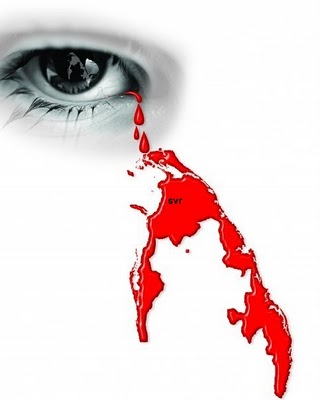
Remarks Of Tamil Genocide in Sri Lanka:
Thursday, March 25, 2010

Wednesday, March 17, 2010
Tamils From Ireland - Facebook
The panel of experts being set up by the United Nations as part of an accountability process following the end of the civil war in Sri Lanka will not infringe on the country’s sovereignty, Secretary-General Ban Ki-moon said Tuesday. Mr. Ban told journalists that the establishment of the panel is in line with a joint statement he issued with Sri Lankan President Mahinda Rajapaksa during his visit to the country last May after Government forces defeated the Liberation Tigers of Tamil Eelam (LTTE), according to UN News Centre press release Tuesday
Irish Tamil Forum
Rasaratham Suresh, a Tamil from Jaffna in Sri Lanka travelled a long way from his home town to a country he had hardly heard about before. His story illustrates how a mixture of political turmoil and economic hardship drives people from their home countries. It also shows how travel destinations unexpectedly change.
Interview by Jakub Boratynski
On a chilly February morning, the refugee reception centre in Debak near Warsaw is nearly empty. The day before, a large group of Somalis was moved to another centre in southern Poland. That's why Rasaratham Suresh does not have too many customers in the canteen where he sells cigarettes, candies and beer so we sit at an old wooden table and talk.
Last autumn, the 31-year-old Tamil arrived in a country he had hardly heard of before. Coming from a well-off middle class family in Jaffna, Rasaratham earned a degree in electronic engineering from the University of Colombo. He later married Kalevani, his high school sweetheart, who teaches the traditional Indian dance Bharatha Natiyam. Rasaratham says he never wished for anything extraordinary, just a simple, peaceful existence and a happy family life. He took seriously what his father, a former political activist, used to tell him: "Tamils do not have it easy. So study hard and find a good job." But it did not quite work out that way.
"Problems started when I was looking for my first job," he recalls now. "Any employer who realized that I was a Tamil no longer wanted to talk to me. Any young Tamil like me was automatically suspected of being a member of the Tamil Tigers" – the army of the separatist movement in northern Sri Lanka.
Rasaratham, like many Sri Lankans of his generation, eventually found a job in one of the Persian Gulf countries. But he returned home after he received more and more worrying news about the safety of his family in Jaffna. In October 1991, his house was bombed. Kalevani survived by chance because she had gone to the kitchen just before the blast. "Before that incident we had problems but we could still stay in our house," Rasaratham said. "When that was destroyed and we lost everything, I really felt like a refugee." After that, as the frontlines continually shifted, so the Rasarathams were constantly forced to move from one place to another in search of safety.
In June 1994, during a routine police check in Colombo, Rasaratham was arrested and held for two weeks. He was released after his family paid the equivalent of $1,000, only to be arrested again in similar circumstances in August 1995. He says as a young Tamil, he was doomed to have problems either with the government or with the Tigers who tried to recruit young Tamils. "I neither wanted to work for the government nor was I keen on fighting for the Tigers," he says.
"My little daughter had a serious hearing problem as a result of the shelling. I was really afraid for her," he said. It finally made him decide to get out of Sri Lanka. This cost him $20,000, practically all the savings his brother had made while working in a restaurant in the mountain resort of St. Gallen in Switzerland. The money went to a smuggler in Colombo who euphemistically called himself a 'travel agent.'
Everything then happened very quickly. He recalls taking a taxi to the airport, where he showed his brand new passport and ticket. "The 'travel agent' had told me that everything was O.K. and I shouldn't worry," Rasaratham laughs sarcastically, "I really was not worried at that point. I thought that the $20,000 would get me to Zurich." To his astonishment the signs at the airport where he and his family landed read MOSCOW. In the arrival area, they were approached by a Russian who spoke little English but nevertheless collected the 'balance' of the money owed the so-called travel agent.
They spent five days in total isolation in a house on the outskirts of Moscow before being bundled into a car for 36 hours and finally dumped at another large house already full of Sri Lankans, Indians and Bangladeshis. "We were crammed into this house like sardines in a tin can," he says. "A guy brought us some water and biscuits. The 'Made in Poland' label on the packet of biscuits told me where I actually was."
Rasaratham was finally taken by the Polish police to a reception centre in the town of Debak where he "spent the first three months just sleeping and eating. It was very depressing." Eventually one of the centre's social workers, Mrs. Ania, asked him to run the canteen where he now earns 200 zloty ($70) per month and escapes the boredom just a little. His wife and daughter Anushika have joined him and life is getting better. "It's very simple," he says. "Here, we don't hear bombs and machine guns."
Asked whether he would like ever to return home, he responds, "Sri Lanka is my only mother country. One day I will go back there. We still have 50 acres of land which is now in the war zone." He points to his friend who has joined us at the canteen's table and says emphatically: "He is a very, very rich man. For generations they had accumulated so much land. Do you believe that if our country was peaceful we would have any economic problems?"
Rasaratham talks a lot about the future. A Polish businessman offered him a job. Mrs. Ania has told him that he could have his engineering degree recognized in Poland. And as more Sri Lankans start to settle in Poland, his wife could perhaps start giving dancing classes. At heart, whether in Sri Lanka or Poland, Rasaratham is an optimist. That is in sharp contrast to many asylum-seekers striving to make it to western Europe.
Interview by Jakub Boratynski
On a chilly February morning, the refugee reception centre in Debak near Warsaw is nearly empty. The day before, a large group of Somalis was moved to another centre in southern Poland. That's why Rasaratham Suresh does not have too many customers in the canteen where he sells cigarettes, candies and beer so we sit at an old wooden table and talk.
Last autumn, the 31-year-old Tamil arrived in a country he had hardly heard of before. Coming from a well-off middle class family in Jaffna, Rasaratham earned a degree in electronic engineering from the University of Colombo. He later married Kalevani, his high school sweetheart, who teaches the traditional Indian dance Bharatha Natiyam. Rasaratham says he never wished for anything extraordinary, just a simple, peaceful existence and a happy family life. He took seriously what his father, a former political activist, used to tell him: "Tamils do not have it easy. So study hard and find a good job." But it did not quite work out that way.
"Problems started when I was looking for my first job," he recalls now. "Any employer who realized that I was a Tamil no longer wanted to talk to me. Any young Tamil like me was automatically suspected of being a member of the Tamil Tigers" – the army of the separatist movement in northern Sri Lanka.
Rasaratham, like many Sri Lankans of his generation, eventually found a job in one of the Persian Gulf countries. But he returned home after he received more and more worrying news about the safety of his family in Jaffna. In October 1991, his house was bombed. Kalevani survived by chance because she had gone to the kitchen just before the blast. "Before that incident we had problems but we could still stay in our house," Rasaratham said. "When that was destroyed and we lost everything, I really felt like a refugee." After that, as the frontlines continually shifted, so the Rasarathams were constantly forced to move from one place to another in search of safety.
In June 1994, during a routine police check in Colombo, Rasaratham was arrested and held for two weeks. He was released after his family paid the equivalent of $1,000, only to be arrested again in similar circumstances in August 1995. He says as a young Tamil, he was doomed to have problems either with the government or with the Tigers who tried to recruit young Tamils. "I neither wanted to work for the government nor was I keen on fighting for the Tigers," he says.
"My little daughter had a serious hearing problem as a result of the shelling. I was really afraid for her," he said. It finally made him decide to get out of Sri Lanka. This cost him $20,000, practically all the savings his brother had made while working in a restaurant in the mountain resort of St. Gallen in Switzerland. The money went to a smuggler in Colombo who euphemistically called himself a 'travel agent.'
Everything then happened very quickly. He recalls taking a taxi to the airport, where he showed his brand new passport and ticket. "The 'travel agent' had told me that everything was O.K. and I shouldn't worry," Rasaratham laughs sarcastically, "I really was not worried at that point. I thought that the $20,000 would get me to Zurich." To his astonishment the signs at the airport where he and his family landed read MOSCOW. In the arrival area, they were approached by a Russian who spoke little English but nevertheless collected the 'balance' of the money owed the so-called travel agent.
They spent five days in total isolation in a house on the outskirts of Moscow before being bundled into a car for 36 hours and finally dumped at another large house already full of Sri Lankans, Indians and Bangladeshis. "We were crammed into this house like sardines in a tin can," he says. "A guy brought us some water and biscuits. The 'Made in Poland' label on the packet of biscuits told me where I actually was."
Rasaratham was finally taken by the Polish police to a reception centre in the town of Debak where he "spent the first three months just sleeping and eating. It was very depressing." Eventually one of the centre's social workers, Mrs. Ania, asked him to run the canteen where he now earns 200 zloty ($70) per month and escapes the boredom just a little. His wife and daughter Anushika have joined him and life is getting better. "It's very simple," he says. "Here, we don't hear bombs and machine guns."
Asked whether he would like ever to return home, he responds, "Sri Lanka is my only mother country. One day I will go back there. We still have 50 acres of land which is now in the war zone." He points to his friend who has joined us at the canteen's table and says emphatically: "He is a very, very rich man. For generations they had accumulated so much land. Do you believe that if our country was peaceful we would have any economic problems?"
Rasaratham talks a lot about the future. A Polish businessman offered him a job. Mrs. Ania has told him that he could have his engineering degree recognized in Poland. And as more Sri Lankans start to settle in Poland, his wife could perhaps start giving dancing classes. At heart, whether in Sri Lanka or Poland, Rasaratham is an optimist. That is in sharp contrast to many asylum-seekers striving to make it to western Europe.
Saturday, February 27, 2010
Sri Lanka soldiers remanded over rape of 9-year old Tamil girl.TamilNet.com

Six Sri Lanka Army (SLA) soldiers were taken into custody for allegedly molesting a nine-year-old Tamil girl at Ki'raan Vaazhaichcheani in the eastern Batticaloa district, sources in Batticaloa said. The victim identified one of the perpetrators during an identification parade held in Batticaloa Magistrate Court. Asian Human Rights Commission (AHRC) reported that the soldiers of the Digiliwatiya camp had threatened the protesting villagers, and the body of one protester was recovered in a pond near the SLA camp after the protests.
The victim "was returning home in the company of two of her friends when soldiers bathing near a well chased after her and raped her. The girl was admitted to a hospital and the medical reports confirmed that she had been sexually abused. It is also reported that the girl who is still being treated at the hospital is being questioned constantly by commando officers," AHRC report said.
The alleged incident happened on the 12th of February. The suspects have been remanded by the Batticaloa Magistrate until 3rd of March, legal sources in Batticaloa said.
When the issue of rape by SLA soldiers was raised by US Secretary of State Hilary Clinton, Sri Lanka's Defense Ministry website carried a refutation, saying "such sadistic allegations are far from the existing realities: far from the truth," and added that "there was no basis whatsoever even to suggest Sri Lankan forces had involved in such gross violence during its three-year humanitarian campaign."
British weekly, The Observer, in December 2009 said that "Tamil women interned after escaping the horrors of the civil war in Sri Lanka were sexually abused by their guards who traded sex for food," reporting on an interview with Vany Kumar, a British medic who was released from internment in September from the camps run by Sri Lanka military.
"Systematic rape of Tamil women in custody and in areas under control of Security forces, and sexual abuse of LTTE women cadres caught during combat, had occured from as early as September 1996 when Krishanthy Kumarasamy, a 17-year old highschooler, was murderd after being stopped and raped at an SLA sentry point at Kaithadi, Jaffna. Horrendous videos showing Sri Lankan soldiers abusing women cadres stripped naked have routinely surfaced," said activist for a Washington-based pressure group.
UN Resolution 1325
The link between maintaining international peace and security, and preventing and responding to sexual violence used as a tactic of war to target civilians was first laid out in last year's United Nation's Security Council resolution 1325.
United Nations charged 114 Sri Lankan soldiers who were on peace-keeping missions to Haiti in March 2008 with sexual exploitation and abuse against children. After an investigation into pending charges against Sri Lankan troops in Haiti, the UN's Office of Internal Oversight Services (OIOS) concluded that “acts of sexual exploitation and abuse [against children] were frequent and occurred usually at night, and at virtually every location where the [Sri Lankan] contingent personnel were deployed.”
Friday, February 26, 2010
Irish Tamil Forum
.Human rights defender Pattani Razeek has been missing since he was apparently abducted on 11 February in the town of Polonnaruwa, in Sri Lanka’s North Central Province. He may be the victim of an enforced disappearance, and could be at risk of torture or other ill-treatment. It is not clear what the authorities are doing to investigate his case.
Pattani Razeek, aged 55, is the head of the Community Trust Fund (CTF), a Sri Lankan NGO based in the town of Puttalam in North Western Province. He was returning from a visit with colleagues when their vehicle was intercepted by a white van. Pattani Razeek approached the men in the other vehicle, and exchanged greetings in Arabic. He returned to his CTF colleagues and said he would join the group in the white van, which according to him was headed for Valaichchenai, a town in Eastern Province. He assured his colleagues that he would meet up with them later. However, they did not see him again, and he never returned home.
On 16 February, Pattani Razeek’s family obtained records of calls made to and from his mobile phone. The records revealed that a number of short calls were made from Pattani Razeek’s phone on the evening of 11 February, the day he went missing. On 15 February, a call from the phone was made to a CTF driver, who did not answer. When the call was eventually[ returned, there was no answer. A text message sent on 15 February to a member of Pattani Razeek’s family said that he was in Polonnaruwa and that he would be home soon. Since then, there has been no further communication.
His family lodged a complaint with the local police in Puttalam, and also reported his disappearance to the Human Rights Commission of Sri Lanka. However, colleagues say the Human Rights Commission failed to give his relatives a reference number which they could use to follow up on the case. Nobody from the Commission has subsequently contacted them. Although Pattani Razeek’s disappearance was reported to the police, colleagues say that police have not been following up leads in the case.
The CTF works to protect human rights and promote equality. It also provides emergency assistance to civilians affected by Sri Lanka’s internal conflict.
PLEASE WRITE IMMEDIATELY in English, Sinhalese, Tamil, or your own language:
* calling on the Sri Lankan authorities to order an immediate and impartial investigation to establish the whereabouts of Pattani Razeek, who went missing on 11 February;
* urging the authorities to ensure that human rights defenders are able to continue their legitimate work without fear of harassment or intimidation.
Pattani Razeek, aged 55, is the head of the Community Trust Fund (CTF), a Sri Lankan NGO based in the town of Puttalam in North Western Province. He was returning from a visit with colleagues when their vehicle was intercepted by a white van. Pattani Razeek approached the men in the other vehicle, and exchanged greetings in Arabic. He returned to his CTF colleagues and said he would join the group in the white van, which according to him was headed for Valaichchenai, a town in Eastern Province. He assured his colleagues that he would meet up with them later. However, they did not see him again, and he never returned home.
On 16 February, Pattani Razeek’s family obtained records of calls made to and from his mobile phone. The records revealed that a number of short calls were made from Pattani Razeek’s phone on the evening of 11 February, the day he went missing. On 15 February, a call from the phone was made to a CTF driver, who did not answer. When the call was eventually[ returned, there was no answer. A text message sent on 15 February to a member of Pattani Razeek’s family said that he was in Polonnaruwa and that he would be home soon. Since then, there has been no further communication.
His family lodged a complaint with the local police in Puttalam, and also reported his disappearance to the Human Rights Commission of Sri Lanka. However, colleagues say the Human Rights Commission failed to give his relatives a reference number which they could use to follow up on the case. Nobody from the Commission has subsequently contacted them. Although Pattani Razeek’s disappearance was reported to the police, colleagues say that police have not been following up leads in the case.
The CTF works to protect human rights and promote equality. It also provides emergency assistance to civilians affected by Sri Lanka’s internal conflict.
PLEASE WRITE IMMEDIATELY in English, Sinhalese, Tamil, or your own language:
* calling on the Sri Lankan authorities to order an immediate and impartial investigation to establish the whereabouts of Pattani Razeek, who went missing on 11 February;
* urging the authorities to ensure that human rights defenders are able to continue their legitimate work without fear of harassment or intimidation.
British Shadow FM calls for political reform, independent war-crime investigations
Noting that "there is a natural affinity between Tamils in Britain and our [Conservative] Party," William Hague, the British Shadow Foreign Secretary, in his speech to the inaugural launch of Global Tamil Forum, warned that the "continued confinement [of thousands] will simply sow the seeds of discontent, [and] could lead to renewed conflict in years to come," called for "meaningful political reform," and said that "there should be a full independent inquiry into alleged war crimes committed by both sides during the final stages of the military conflict
Denmark goes for Tamil referendum Sunday
Eezham Tamils in Denmark will cast their ballot in 32 centres across the country in a referendum on the question of independent and sovereign Tamil Eelam in the North and East of the island of Sri Lanka. The referendum will be conducted by a professional institute TNS Gallup, specialised in sociological and public opinion research services, deploying electronic system for confidential voting, says Dr. Remmon Washington, the spokesperson of the Denmark Tamils Forum formation committee, which has initiated the poll. The total number of eligible Eezham Tamil voters in Denmark is estimated to be ranging around 6,500.
All polling booths will be supervised by a non-Tamil representative, who will liaise with TNS Gallup and will be responsible for giving the individual password necessary for electronic voting at the booth.
When voters enter the password, the statement for the referendum and three columns, 'yes', 'no' and 'blank', will appear in the screen for the voters to choose and submit.
Dr. Remmon WashingtonThe committee appealed to all eligible Eezham Tamil voters to prove solidarity in democratic approach to the national question, through overwhelming participation.
Even though small in number, voters in Denmark have to be conscious about the significant impact they could make, as successful referenda in several diaspora countries have proved it domestically and internationally, says Dr. Remmon Washington, an Eezham Tamil physician who came to Denmark in 1987 at the age
All polling booths will be supervised by a non-Tamil representative, who will liaise with TNS Gallup and will be responsible for giving the individual password necessary for electronic voting at the booth.
When voters enter the password, the statement for the referendum and three columns, 'yes', 'no' and 'blank', will appear in the screen for the voters to choose and submit.
Dr. Remmon WashingtonThe committee appealed to all eligible Eezham Tamil voters to prove solidarity in democratic approach to the national question, through overwhelming participation.
Even though small in number, voters in Denmark have to be conscious about the significant impact they could make, as successful referenda in several diaspora countries have proved it domestically and internationally, says Dr. Remmon Washington, an Eezham Tamil physician who came to Denmark in 1987 at the age
Subscribe to:
Posts (Atom)